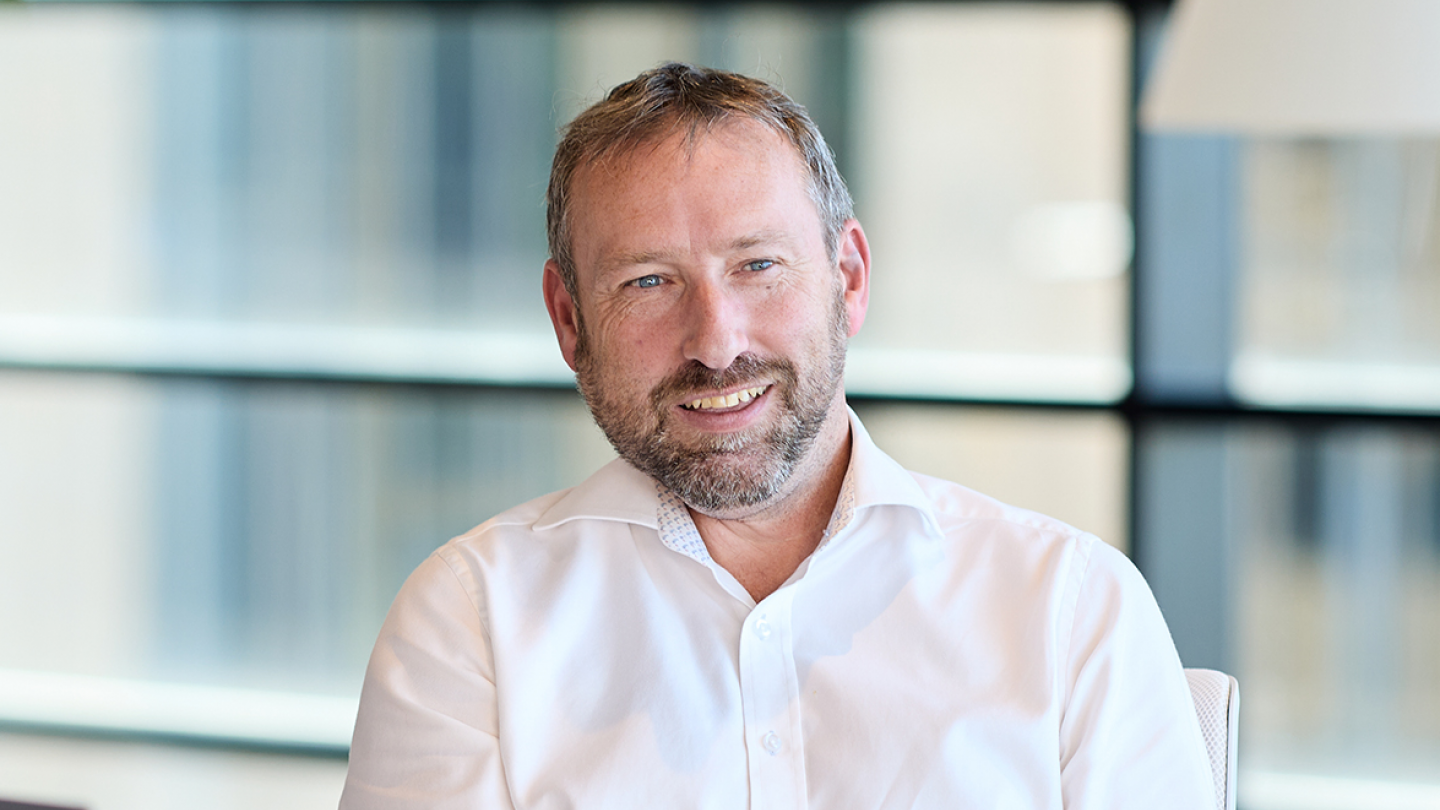
Stuart Dunbar, partner, Baillie Gifford
As with any investment your capital is at risk.
In uncertain times, markets tend to become shortsighted. Investors place less weight on future profits, regardless of the quality of the underlying businesses. As trepidation grows, it can feel as if the mist will never clear.
This creates a mismatch. Compressed valuations can enhance the opportunity for conviction-driven growth investors to deliver long-term returns. But doing so requires patience, just when it is most in short supply.
Since Covid, supply chain disruptions, Russia’s invasion of Ukraine, trade tariffs, advances in AI and now war in the Middle East have all clouded the picture.
“It’s just been one thing after another, and it’s making it very hard for other investors to get comfortable with the notion that what companies are doing three, four or five years from now is predictable and therefore has value,” says Baillie Gifford partner Stuart Dunbar.
“Even so, we remain confident in our companies’ growth prospects. We do the hard work, ensure that we’re not missing anything, and make sure the world hasn’t changed in a way that should cause us to rethink our investment cases. And so long as we do that and dig in our heels, now is actually when we add the most value.”
He explains that we gain this confidence by “knowing what we own”. It sounds simple, but Dunbar argues that only by putting in the effort and resources to understand the businesses we back and those who run them can we resist short-term pressures to sell when shares become mispriced. By regularly meeting senior executives, we can also encourage them to stick to their long-term goals even when pressures mount to do otherwise.
“It used to be that everyone naturally expected an asset manager to allocate clients’ capital to companies and then work with those companies to oversee and encourage good use of that capital,” Dunbar comments.
“That collaboration has started to fall by the wayside. But there’s evidence that companies with quality, large owners on their shareholder registers tend to perform better in the long term.”
Risk aversion is skewing valuations
Dunbar recognises that, following a period of strong performance, some of Baillie Gifford’s strategies have been beaten by passive equivalents in recent years. Passive funds aim to match an index’s returns rather than seek to outperform through research and judgement.
“What’s really been difficult for growth investors such as us in recent years is that the markets are treating growth companies pretty much the same way – the Magnificent Seven excepted – when normally their valuations wouldn’t be so correlated. So there’s a need to look harder to find those that are being overlooked.”
“Companies with long-term growth prospects, which are much better and more stable and predictable than the market, are only trading at a 10 per cent premium, sometimes less. Yet that premium has been as high as 70 per cent in the last five years. I don’t know what the right level is, but we’re not in the right place at the moment.”
As an example, he cites Nu Holdings, the company behind the Latin American fintech Nubank. It has more than 112 million customers in Brazil alone – 61 per cent of the country’s adult population – and is rapidly growing in Colombia and Mexico, with plans to expand into the US.
“There’s a high degree of predictability about its growth,” Dunbar says. “Its margins are way better than traditional banks – it doesn’t have to maintain a clunky, old physical banking infrastructure network.”
Yet at the time of writing, the business’s forward price-to-earnings ratio – comparing its current share price to projected earnings – was below the global average. “How can this company be worth a sub-market multiple when its prospects are long-term, and its margins are potentially terrific? That just doesn’t make sense.”
Looking for growth in more places
However, holding firm doesn’t mean standing still. Dunbar highlights that Baillie Gifford has created a second investment risk team to advise on the mix of companies in portfolios. That should help managers calibrate volatility to client expectations.
Additionally, we are “looking beyond the obvious” when it comes to the companies we cover, including in AI. For example, we added IREN to several portfolios. The Sydney-based company develops and operates renewable-powered datacentres and has secured a major long-term contract with a leading technology company.
Dunbar adds that we are also exploring businesses that might not previously have come on to our radar.
“The sources of growth are broadening out, so we are looking at more esoteric examples,” he explains. “For instance, one of our strategies recently invested in WillScot, an American provider of temporary building site accommodation.”
The investment thesis is that the company will benefit from increased spending on US infrastructure, including road and bridge projects, after years of neglect. WillScot has acquired about 40 other companies since going public in 2017, growing its market share and strengthening its pricing power.
“We’ve always gone wherever we need to look for growth – but this is a different place than people might think we’d explore,” Dunbar says.
So what needs to change for the market to recognise the true worth of such companies? “In very simple terms, we just need a period of stability and predictability,” Dunbar answers.
That might sound like a big ask in the current environment. But he urges long-term-minded clients to remain patient and resist any urge to dip in and out, given the timeline involved is unknowable.
“This level of market trepidation can’t go on forever,” he adds. “But this is when you add the most value by staying invested. If you’re out of tune with the market, don’t give in.”
For more information, visit Baillie Gifford’s website.
Important information
This article does not constitute, and is not subject to the protections afforded to, independent research. Baillie Gifford and its staff may have dealt in the investments concerned. The views expressed are not statements of fact and should not be considered as advice or a recommendation to buy, sell or hold a particular investment.
Baillie Gifford Investment Management (Europe) Ltd is authorised and regulated by the Central Bank of Ireland as a UCITS management company and as an AIFM, and to provide discretionary portfolio management.